 Tailwatch
Track local news and police helicopters on a Mac
When a helicopter circles your neighborhood, you usually want to know two things: who is it, and what are they looking at? Here is how to find out, and how to hear about it next time before you hear the rotor.
Most helicopters announce themselves
Nearly every TV news helicopter, and many police and medical helicopters, carry an ADS-B transponder. Several times a second it broadcasts the aircraft's identity, position, altitude and speed. Volunteers around the world run small receivers that pick up those broadcasts and share them through networks such as adsb.lol. That public data is what flight tracking apps show.
Find the one overhead
- In Tailwatch, click Layers and turn on Traffic.
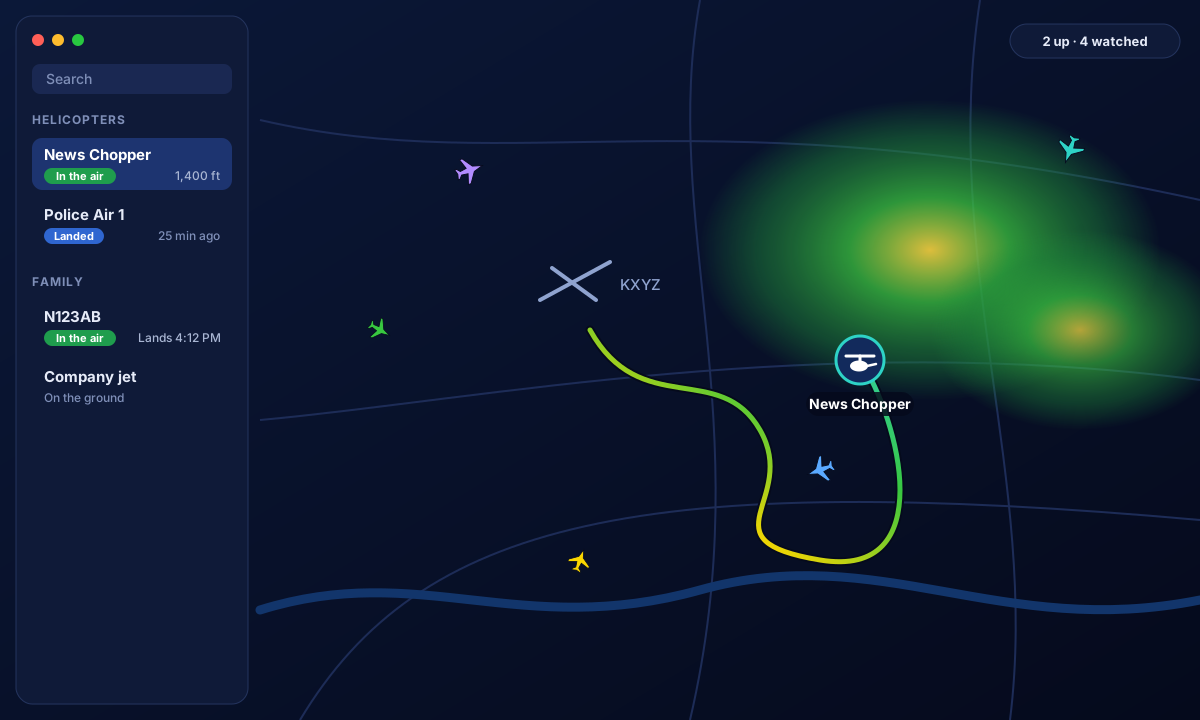
- Look for the helicopter symbol near you. Helicopters get their own shape, so they stand out from airplanes.
- Click it. The card shows its registration, its type, and its path so far.
The path tells the story. A news helicopter holds a tight orbit around whatever it is filming. A police helicopter flies slower, lower search patterns. A medical helicopter goes in a straight line to a hospital helipad.
Add it to your watchlist
Click Add to Watchlist on the card and give it a name you'll recognize, like "Channel 6" or "Police Air 1". From then on Tailwatch watches for it in the background, even with the window closed.
Most stations and departments fly the same one or two aircraft for years, so adding each one once covers you. Local aviation forums and the aircraft's registration record are good ways to confirm which is which.
Get an alert when it takes off
Open the aircraft's Edit sheet and turn on the takeoff alert. A few options make it more useful:
- Nearby only limits alerts to when the helicopter is near your Home, so you aren't told about flights across town.
- Quiet hours silence alerts overnight.
- Emergency alerts tell you if a watched aircraft squawks an emergency code.
What to expect, honestly
- Low flights can drop out. ADS-B needs a receiver with a clear view of the aircraft. A helicopter working low between buildings or hills may disappear and reappear. Tailwatch treats a low dropout as a possible landing only after it stays gone for a few minutes.
- Not every helicopter broadcasts. Some law enforcement and military flights don't, and some operators ask the FAA to limit how their aircraft are shown. Tailwatch hides those from general traffic by default.
- Speed depends on your data source. On the free tier a takeoff may be noticed a few minutes late. With your own receiver, nearby helicopters update every second or two, which suits them well because they fly close to you.
Why a Mac app
You can do all of this on a flight tracking website by leaving a tab open and checking it. Tailwatch does the checking for you, and it adds weather radar, weather warnings and flight restrictions to the same map, which often explain why the helicopter is up in the first place.